

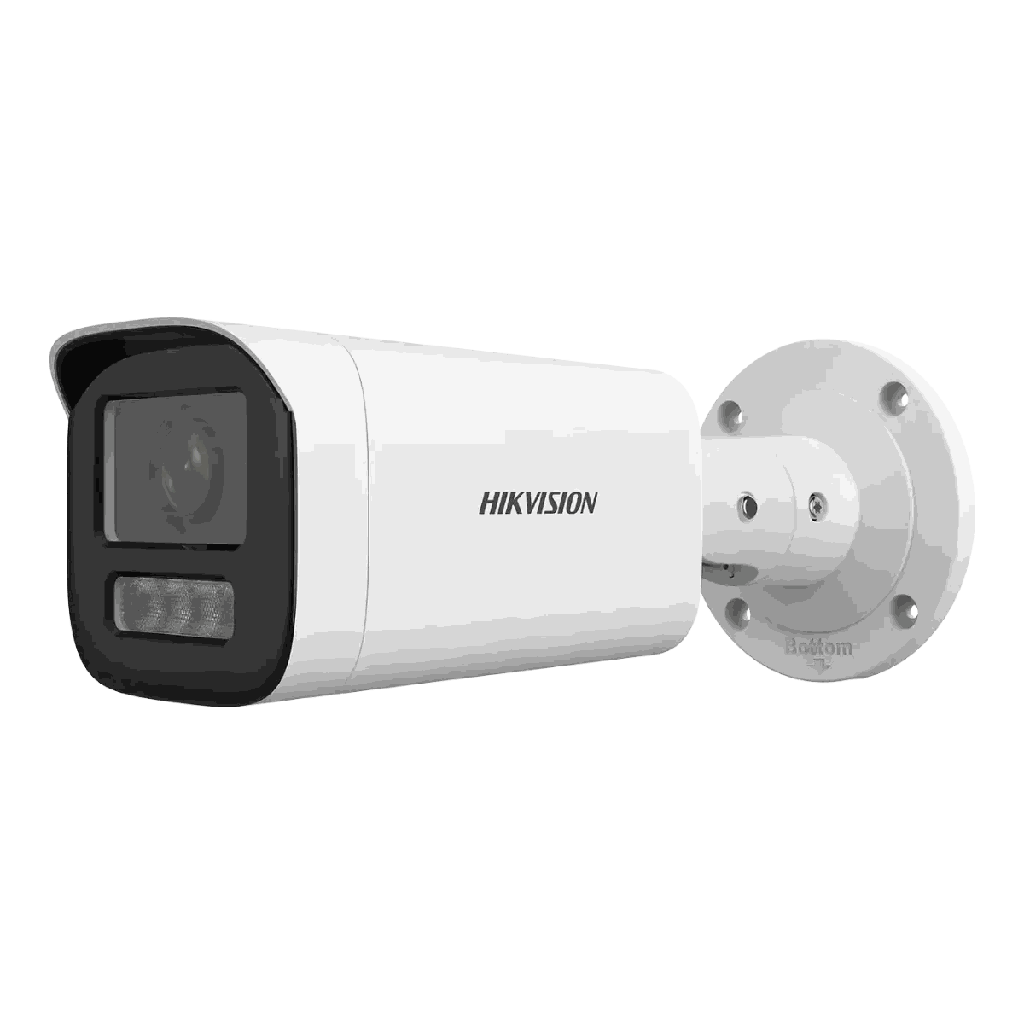
DS-2CD1663G2-LIZSU
6MP Smart Hybrid Light Motorized Varifocal Bullet Camera, 2.8 to 12 mm lens
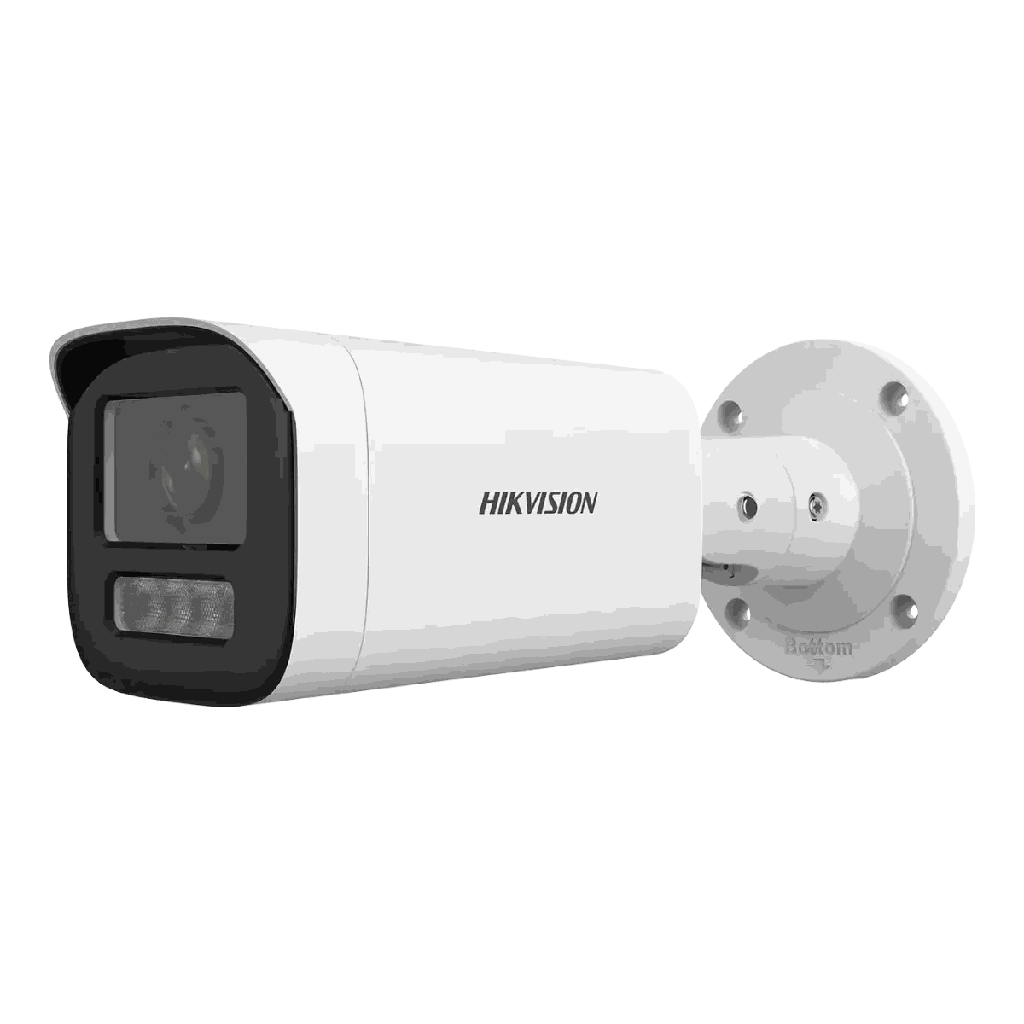
DS-2CD1663G2-LIZSU
6MP Smart Hybrid Light Motorized Varifocal Bullet Camera, 2.8 to 12 mm lens
Resolution
2MP (1920 × 1080) Full HD
IR Range
Up to 60m with EXIR Technology
Frame Rate
50Hz: 25fps (1920 × 1080, 1280 × 960, 1280 × 720)
Video Compression
Main stream: H.265/H.264
Sub-stream: H.265/H.264/MJPEG
Third stream:H.265/H.264
Interface
Alarm I/O, Audio I/O, Built-in SD Card Slot (Up to 128G)
Smart Features
120dB WDR, 3D DNR, BLC, HLC, ROI, Behavior Analysis, Face Detection
Protection Level
IP67 Weatherproof, IK10 Vandal Proof
Alarms Trigger
Motion detection, Intrusion Detecting, line crossing
Video tampering alarm, network disconnected
IP address conflicted, illegal login
Key specs
- 6MP (3200 × 1800), 2.8 to 12 mm motorized varifocal lens
- Smart Hybrid Light (IR and white light), up to 50 m at night
- Motion Detection 2.0: people and vehicles
- Built-in microphone
- Audio and alarm terminals
- microSD up to 512 GB
- H.265+ compression
- IP67
- 12 VDC or PoE power
| Camera | |
|---|---|
| Image Sensor | 1/2.4" Progressive Scan CMOS |
| Max. Resolution | 3200 × 1800 |
| Min. Illumination | Color: 0.005 Lux @ (F1.6, AGC ON), B/W: 0 Lux with IR |
| Day & Night | IR cut filter |
| Angle Adjustment | Pan: 0° to 355°, tilt: 0° to 70°, rotate: 0° to 355° |
| Lens | |
| Lens Type | Varifocal lens, motorized lens, 2.8 to 12 mm |
| Focal Length & FOV | 2.8 to 12 mm, horizontal FOV 106° to 35.6°, vertical FOV 55.9° to 20°, diagonal FOV 127.4° to 40.8° |
| Aperture | F1.6 |
| DORI | |
| DORI | D: 68 to 200 m, O: 27 to 79 m, R: 13.6 to 40 m, I: 6.8 to 20 m |
| Illuminator | |
| Supplement Light Type | IR, White Light |
| Supplement Light Range | Up to 50 m |
| Smart Supplement Light | Yes |
| Video | |
| Main Stream | 50 Hz: 20 fps (3200 × 1800, 2688 × 1520, 1920 × 1080, 1280 × 720); 60 Hz: 20 fps (3200 × 1800, 2688 × 1520, 1920 × 1080, 1280 × 720) |
| Video Compression | Main stream: H.265+/H.265/H.264+/H.264, Sub-stream: H.265/H.264/MJPEG |
| Audio | |
| Audio Type | Mono sound |
| Environment Noise Filtering | Yes |
| Network | |
| API | Open Network Video Interface (Profile S, Profile G, Profile T), ISAPI, SDK |
| Client | iVMS-4200, Hik-Connect |
| Image | |
| Wide Dynamic Range (WDR) | 120 dB |
| Image Enhancement | BLC, HLC, 3D DNR |
| Day/Night Switch | Day, Night, Auto, Schedule |
| Interface | |
| Ethernet Interface | 1 RJ45 10 M/100 M self-adaptive Ethernet port |
| On-Board Storage | Built-in memory card slot, support microSD/microSDHC/microSDXC card, up to 512 GB |
| Built-in Microphone | Yes |
| Audio | 1 input (line in), two-core terminal block, max. input amplitude: 3.3 Vpp, input impedance: 4.7 KΩ, interface type: non-equilibrium; 1 output (line out), two-core terminal block, max. output amplitude: 3.3 Vpp, output impedance: 100 Ω, interface type: non-equilibrium |
| Alarm | 1 input, 1 output (max. 12 VDC, 30 mA) |
| Reset Key | Yes |
| Event | |
| Basic Event | Motion detection (support alarm triggering by specified target types (human and vehicle)), video tampering alarm, exception |
| Linkage | Upload to FTP/memory card, notify surveillance center, send email, trigger recording, trigger capture, trigger alarm output, audible warning |
| General | |
| Power | 12 VDC ± 25%, 0.88 A, max. 10.5 W, Ø 5.5 mm coaxial power plug, reverse polarity protection; PoE: IEEE 802.3af, Class 3, max. 12 W |
| Protection | IP67: IEC 60529-2013 |
| Material | Metal & Plastic |
| Dimension | Ø 105 mm × 252 mm (Ø 4.1" × 9.9") |
| Weight | Approx. 750 g (1.7 lb.) |
| Startup and Operating Conditions | -30 °C to 60 °C (-22 °F to 140 °F). Humidity 95% or less (non-condensing) |
Source: Hikvision datasheet.
Know before you buy
Quick answers about the DS-2CD1663G2-LIZSU 2.8-12mm, and how it compares.
1 Line or 2 Line: which one do I need?
Both record clear video and work with any Hikvision NVR. The difference is how smart and how strong the camera is.
- 1 Line (DS-2CD1xxx, Value Series): Motion Detection 2.0 or 3.0 tells people and vehicles apart, so you get far fewer false alerts. Good for homes, shops and small offices.
- 2 Line (DS-2CD2xxx, Pro Series): adds perimeter rules (line crossing, intrusion, entering or leaving an area), a bigger sensor, a higher frame rate and a longer night range. Many models also add face capture, unattended baggage and object removal. Good for factories, warehouses, schools and any site with a wall or fence to guard.
- 3 Line and above: project cameras for very dark sites (DarkFighter), loitering, number plate reading, face recognition and people counting. Contact us.
Choose 1 Line for good video and clean motion alerts. Choose 2 Line if you want an alarm the moment someone climbs a wall or walks into a yard at night.
G2 or G3: what changes?
G3 is the newer generation. Its HikAI-ISP cleans night grain and glare before detection runs, so headlights, torches and reflections cause far fewer false alarms: Hikvision states up to 80% fewer. Motion Detection 3.0 follows a person as one target even when they pass behind a tree or pole. G3 also saves search tags with the video (person or vehicle, clothing colour, vehicle colour) for AcuSeek.
G2 is still a good camera with Motion Detection 2.0, and the better buy when budget decides.
What is Smart Hybrid Light?
The camera has two lights. In the dark it uses invisible IR light and records in black and white. When it detects a person or vehicle, it switches on white light and records in colour, so you can see clothing and car colours. When the scene is quiet again, it goes back to IR.
In the settings you can also choose IR only (no visible light, useful near a neighbour's window) or white light only.
What do Motion Detection, AcuSense, perimeter protection, AcuSearch and AcuSeek mean?
- Motion Detection 2.0 / 3.0: old motion detection alarms on anything that moves: a cat, leaves, rain, car lights. Motion Detection 2.0 first checks "Is this a person or a vehicle?" and only then alerts you. 3.0 (G3 cameras) also ignores headlights and torches, and keeps following a person who walks behind a tree. Example: at 2 am a cat walks on your wall: no alert. A man climbs the gate: your phone rings.
- AcuSense: the brain that tells people and vehicles apart. It also marks each recording "person" or "vehicle", so you can play back only those clips. Example: instead of watching 10 hours of night video, you tap "person" and see the 4 clips that matter.
- Perimeter protection: you draw on the screen where people should not go. Line crossing alarms when someone crosses a line (top of the back wall). Intrusion alarms when someone enters an area and stays a few seconds (the yard after 10 pm). Region entrance and exit alarms the moment someone goes in or out (the cash room, a car leaving the garage). Built into 2 Line cameras; for 1 Line cameras an AI NVR can do it on 1 or 2 cameras.
- AcuSearch: click a person or car in old video, and the NVR shows every clip where it appears, on all cameras. Needs a Pro I NVR or higher. Example: a parcel is missing from reception. Click the delivery man once and see where he went and when he left.
- AcuSeek: search video by typing words, like Google: "white car at the gate", "man in red shirt with a bag". G3 cameras describe what they see; the search runs on a VPro or DeepinMind NVR. Example: the guard says "a white Corolla came around 4 pm". You have the clip in seconds.
What does the camera do, and what does the NVR add?
The camera detects; the recorder finds.
- Recording and playback: the NVR records all your cameras and lets you play back only the clips with people or vehicles.
- AI for older cameras: a Hikvision NXI NVR has its own AI engine. It can give basic cameras, such as the low-cost G0-I range, Motion Detection with AcuSense on all channels. It can also add intrusion and line crossing, or face capture and recognition, but only on 1 or a few cameras. Most AI NVRs (Pro K and Pro I) run one engine at a time: you choose Motion Detection, Perimeter Protection, Face (Target Recognition) or AcuSearch, depending on what your site needs most. Higher VPro and DeepinMind (/X) NVRs in the 77 and 96 series can run several engines together. A camera like this one has AcuSense built in, so it does not use up the NVR's engine.
- Only on higher NVRs: AcuSearch (click a person and see every clip) on Pro I, AcuSeek (search by typing words) on VPro or DeepinMind, face comparison on Pro I or DeepinMind, and following one person across several cameras.
Which Hikvision NVR should I pair it with?
Any Hikvision NVR records it. Choose the NVR by what you want to do with the video later:
- Value (NI-Q): basic recording at the lowest price. Homes and small shops.
- Pro K (NXI-K): playback filtered to people or vehicles, and Motion Detection 2.0 for older cameras on the same recorder. Most shops and offices.
- Pro I (NXI-I): AcuSearch and two independent screens. Sites with many cameras.
- Ultra M (NI-M): the strongest recorder, for 64 to 256 cameras, RAID and video walls. It has no AI engine of its own, so the smart features come from the cameras.
- VPro: AcuSeek, search by typing words such as "white van".
- DeepinMind (iDS ... /X): face recognition and AI on many channels.
Channels, hard disk bays and incoming bandwidth matter too. Our engineers size these with your quote.
Can this camera recognise faces?
Face features come in three steps:
- Face detection: the system sees that a face is in the picture.
- Face capture: it saves a clear photo of each face, with the time and the camera, so you can look through faces instead of hours of video.
- Face recognition: it compares each face with your list (staff, VIP, blocked) and alerts you by name, or as a stranger.
This camera does not capture faces by itself. A Hikvision AI NVR, even a low-cost one like the DS-7604NXI-K1, can capture and recognise faces from it on 1 or 2 cameras.
For good results the camera must see people from the front at head height, with light on their faces.
What happens to my recordings if a hard disk fails or the NVR is stolen?
It depends on the NVR body and on the microSD card in the camera:
- 76xx NVR (1 or 2 hard disks): if one disk fails, the video on it is lost, but the NVR keeps recording on the other disk. With only one disk, a failure means you lose everything recorded and recording stops until you replace it.
- 77xx NVR (up to 4 hard disks): same idea with more disks. A failed disk loses its own video; the other disks keep recording.
- 86xx and 96xx NVR (RAID): the disks protect each other. If one disk fails, you lose nothing and recording continues. Replace the disk and the NVR rebuilds the data.
- microSD card in the camera (models with a card slot): keeps the last days of video inside the camera. If the hard disk fails, or intruders take the NVR away, the recording of that night is still in the camera on the wall. If the network drops, the camera records to the card and the NVR copies the gap back later (ANR).
Example: thieves break into a shop and take the NVR. The cameras with a microSD card still have the video of them coming in.
Can I buy this camera online?
We sell only DIY products online, such as dashcams and EZVIZ Wi-Fi cameras. Hikvision IP cameras are installed products. Every site needs a survey, cabling, installation and commissioning, and these change with the location, the number of cameras and the distances.
So please start with a free pre-sales consultation: our engineers will suggest the right cameras, recorder and storage for your site and send you a quote. You can then buy from us or visit our offices in Karachi, Lahore, Islamabad and Rawalpindi. Use the Request a Quote button on this page, contact us or WhatsApp us on +92 300 ESCO 301.
Every Hikvision camera from ESCO comes with a 1 year carry-in warranty.