

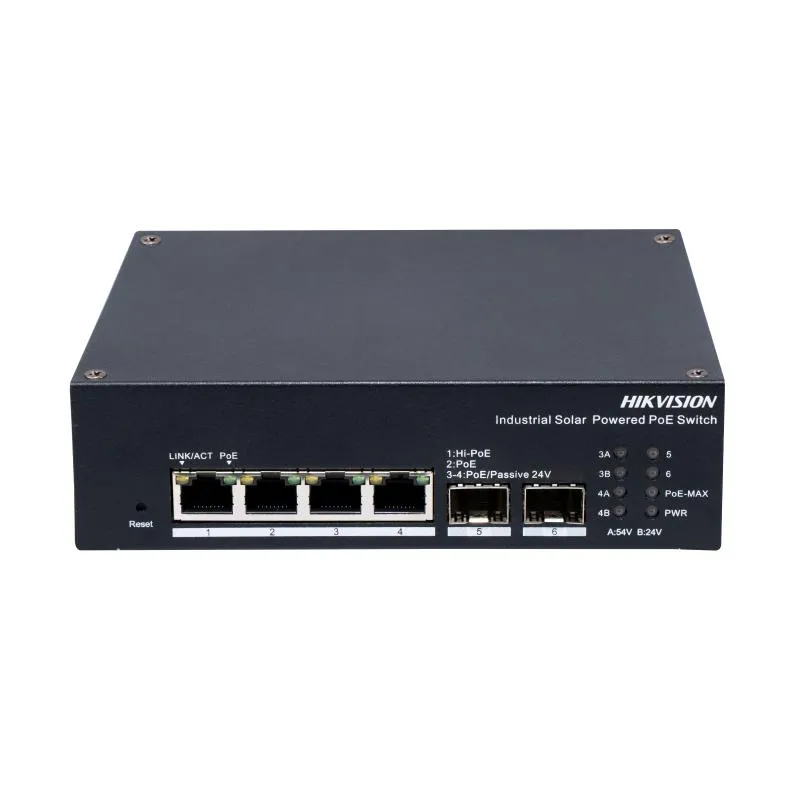
DS-3T1506HP-EI-UPS
4-Port Industrial Solar PoE Switch, Hi-PoE
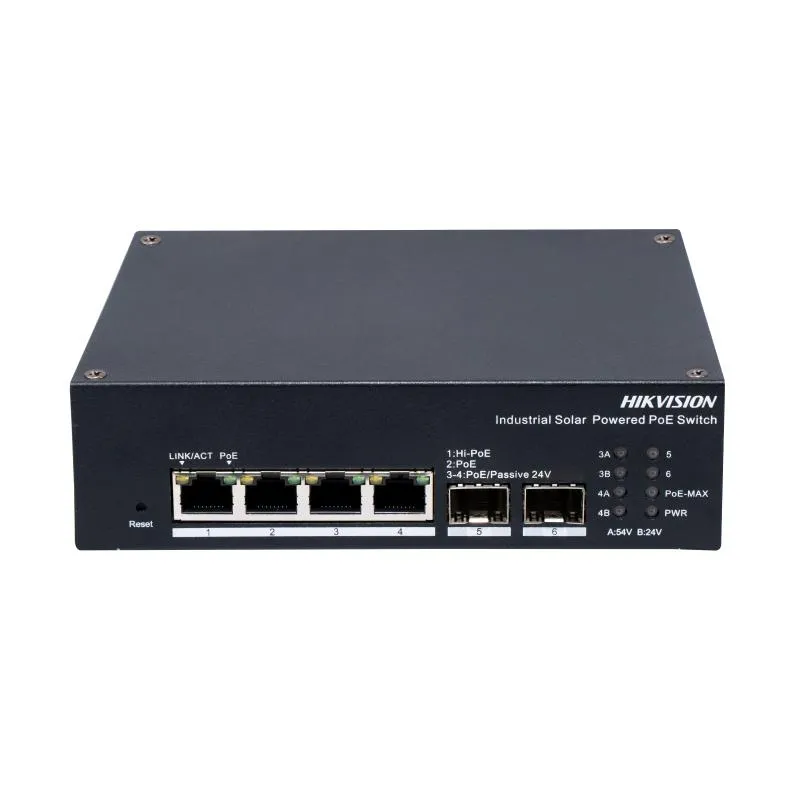
- 4 Gigabit PoE + 2 SFP fiber ports
- 12-24 V solar input, battery monitoring
- Hi-PoE up to 90 W, 24 V passive PoE
- -40 °C to 75 °C wide temperature
DS-3T1506HP-EI-UPS
4-Port Industrial Solar PoE Switch, Hi-PoE
- 4 Gigabit PoE + 2 SFP fiber ports
- 12-24 V solar input, battery monitoring
- Hi-PoE up to 90 W, 24 V passive PoE
- -40 °C to 75 °C wide temperature
Key specs
- 4 × Gigabit PoE ports, 2 × Gigabit SFP fiber ports
- 802.3bt Hi-PoE, max. 90 W on one port
- 24 V passive PoE output for wireless bridges
- Power input: 12 V to 24 V solar, or DC 54 V
- Battery health monitoring in Hik-Partner Pro and Hik-Connect
- Power consumption schedule
- Operating temperature -40 °C to 75 °C (-40 °F to 167 °F)
- 6 kV surge protection
Know before you buy
Quick answers about the DS-3T1506HP-EI-UPS, and how it compares.
What are the SFP fiber ports for?
SFP and SFP+ ports take a small plug-in fiber module, sold separately. Use them to link the switch to the NVR room or main switch when the distance is over 100 m (330 ft), or between buildings. Fiber carries no electricity, so it also stops surges travelling between buildings. Choose single-mode or multi-mode modules to match your fiber cable, and use a matching pair of modules at the two ends. Ask us for the right modules and cable.
What is Hi-PoE (802.3bt)?
Hi-PoE (IEEE 802.3bt) sends much more power on one network cable than normal PoE: up to 90 W on a port of this switch, compared with 30 W for PoE+. Use it for PTZ cameras, cameras with heaters or strong IR, and other high-power devices, so you do not need a separate power supply at the camera. The total PoE budget of the switch still applies.
When do I need an industrial switch?
Industrial switches are made for outdoor cabinets, poles, factories and rooftops. They have no fan, a strong metal housing, and work from -40 °C to 75 °C (-40 °F to 167 °F), where a normal office switch can fail in a Pakistani summer. Use one in a field cabinet near the cameras and link it back to the control room.
Can this switch run on solar power?
Yes. Connect it to a 12 V to 24 V solar battery system, or run it on 54 V DC. You can check the battery health in Hik-Partner Pro and Hik-Connect, and set a power schedule to save energy. Size the solar panel and battery for the total load of the switch and the cameras it powers. Ask us to size the solar kit.