



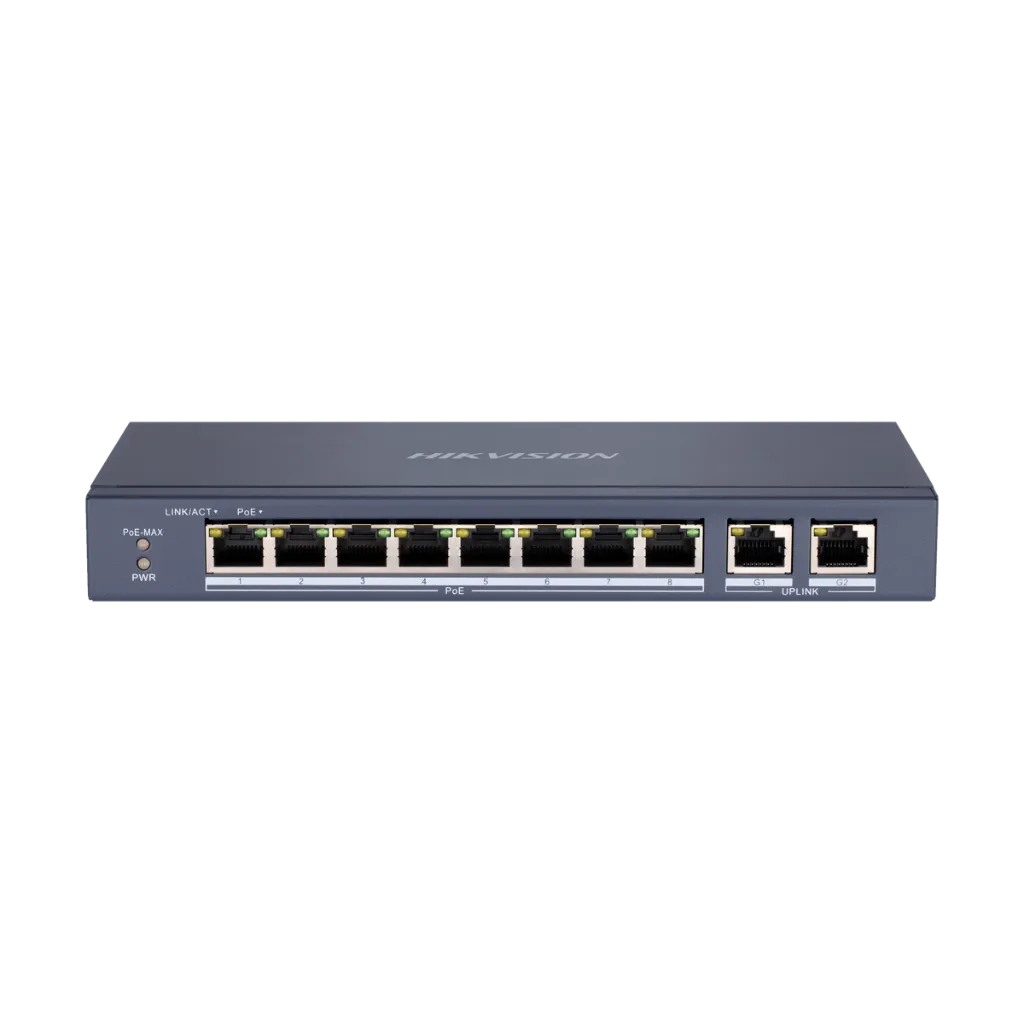
DS-3E0310P-E/M
8-Port PoE Switch, Gigabit Uplinks
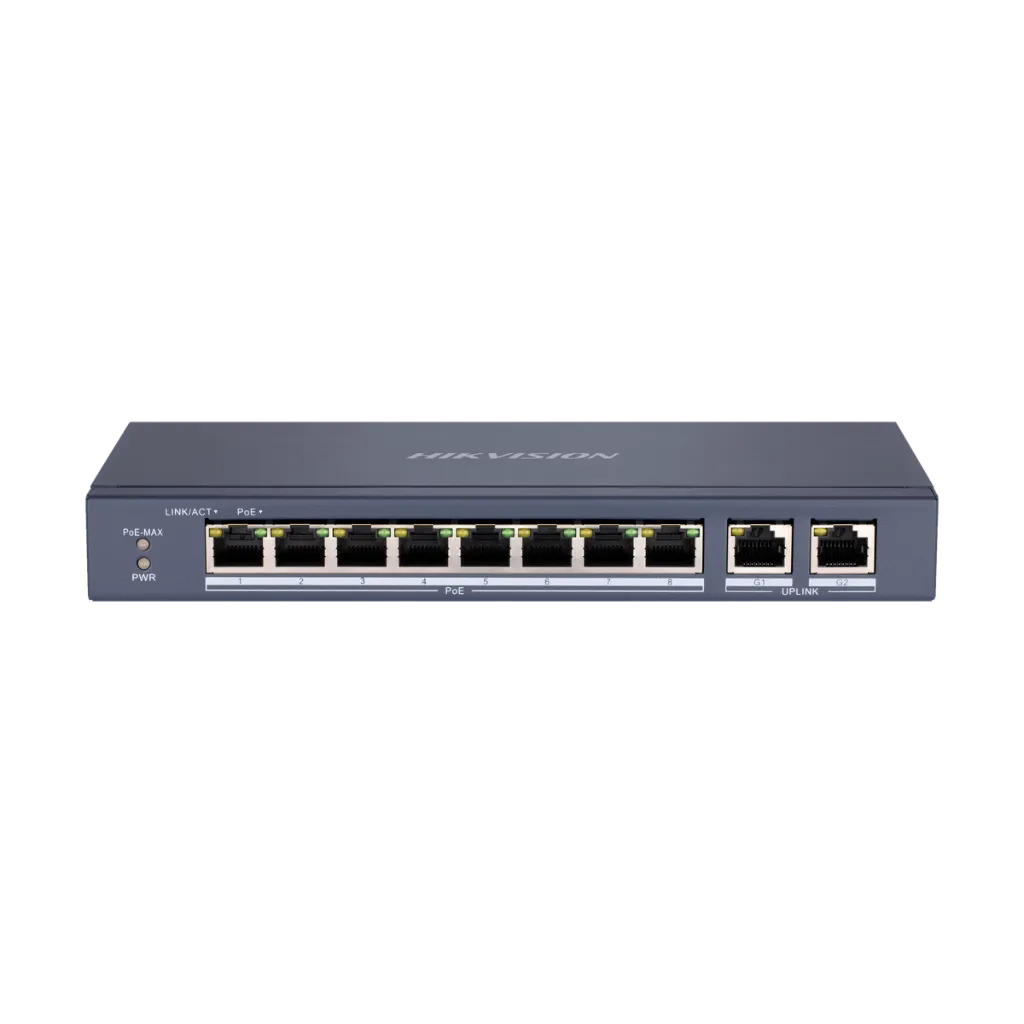
- 8 PoE ports, 60 W budget
- 2 Gigabit uplink ports
- Long-range PoE up to 300 m (1,000 ft)
- 6 kV surge protection
DS-3E0310P-E/M
8-Port PoE Switch, Gigabit Uplinks
- 8 PoE ports, 60 W budget
- 2 Gigabit uplink ports
- Long-range PoE up to 300 m (1,000 ft)
- 6 kV surge protection
PoE Ports
8 x 10/100 Mbps PoE ports
Non-PoE Ports
2 x 10/100/1000 Mbps uplink RJ45 port
PoE Standard
Supports IEEE802.3at/af
PoE power budget
60W
Mac Address Table
16 K
Switching Capacity
5.6 Gbps
Packet Forwarding Rate
4.1664 Mpps
Working Modes
Standard and Extend Mode
Key specs
- 8 × 10/100 Mbps PoE ports (802.3af/at)
- 2 × Gigabit RJ45 uplink ports
- PoE budget 60 W
- Long-range PoE up to 300 m (1,000 ft)
- 6 kV surge protection
- 48 VDC, 1.35 A
|
Network Parameters |
|
|
Port Number |
8 × 10/100Mbps PoE ports, and and 2 × Gigabit RJ45 ports |
|
Port Type |
RJ45 port, full duplex, MDI/MDI-X adaptive |
|
Standard |
IEEE 802.3, IEEE 802.3u, IEEE 802.3x, IEEE 802.3z and IEEE 802.3ab |
|
Forwarding mode |
Store-and-forward switching |
|
Working mode |
Standard mode (default), Extend mode |
|
Ports for long-distance transmission |
Ports 1 to 8 |
|
MAC address table |
16 K |
|
Switching capacity |
5.6 Gbps |
|
Packet forwarding rate |
4.1664 Mpps |
|
Internal cache |
4 Mbits |
|
Internal cache |
768 Kbits |
|
PoE Power Supply |
|
|
PoE standard |
Ports 1 to 8: IEEE 802.3af, IEEE 802.3at |
|
PoE power pin |
Ports 1 to 4: Ethernet cables 1/2/3/6 and 4/5/7/8 provide power supply simultaneously. |
|
PoE port |
Ports 1 to 8 |
|
Max. port power |
Ports 1 to 8: 30 W |
|
PoE Power Budget |
60 W |
|
Dialing function |
|
|
Long range |
Ports 1 to 8: up to 300 m. |
|
General |
|
|
Shell |
Metal material, fan-free design |
|
Gross weight |
1.20 kg (2.65 lb) |
|
Net weight |
0.555 kg (1.22 lb) |
|
Dimension (L × H × D) |
217.6 mm × 103.35 mm × 27.8 mm (8.57” × 4.07” × 1.09”) |
|
Operating temperature |
-10°C to 40°C (14°F to 104°F) |
|
Storage temperature |
-40°C to 85 °C -40°F to 185°F) |
|
Operating humidity |
5% to 95% (no condensation) |
|
Storage humidity |
5% to 95% (no condensation) |
|
Power supply |
48 VDC, 1.35 A |
|
Power consumption in idle |
< 5 W |
|
Max. power consumption |
65 W |
|
Power source |
65 W |
Know before you buy
Quick answers about the DS-3E0310P-E/M, and how it compares.
How many cameras can this PoE switch power?
Two limits apply: the number of PoE ports, and the total PoE budget in watts. Add up the maximum power of each camera from its datasheet and keep about 20% spare. Example: 16 cameras at 6 W each need 96 W, plus 20% is about 115 W, so a switch with a 125 W budget or more is right. A PoE port (802.3af) gives up to 15.4 W and a PoE+ port (802.3at) up to 30 W. PTZ cameras and cameras with heaters, strong IR or strobe lights need PoE+ or Hi-PoE (802.3bt). Not sure? Send us your camera list and we size it for you.
What is long-range PoE, up to 300 m?
A normal network cable run is limited to 100 m (330 ft). In long-range (extend) mode the switch lowers the port speed to 10 Mbps, so data and power can travel up to 300 m (1,000 ft) on one good quality copper Cat6 cable. 10 Mbps is enough for one camera, so use this mode for one camera per port, for example at a far gate or along a boundary wall. For longer runs use fiber with SFP modules.
Unmanaged, smart or managed switch: which one do I need?
Unmanaged switches are plug and play, with nothing to set up: good for small systems. Smart (web managed) switches add a web page and app view for VLANs, port status, cable checks and, on many models, PoE watchdog, so you can find and fix problems from your desk. Managed (Layer 2+ or Layer 3) switches add full control, routing and ring protection for large sites, campuses and city projects. For most CCTV jobs with 8 to 48 cameras, a smart PoE switch is the best value. Ask us if you are not sure.